
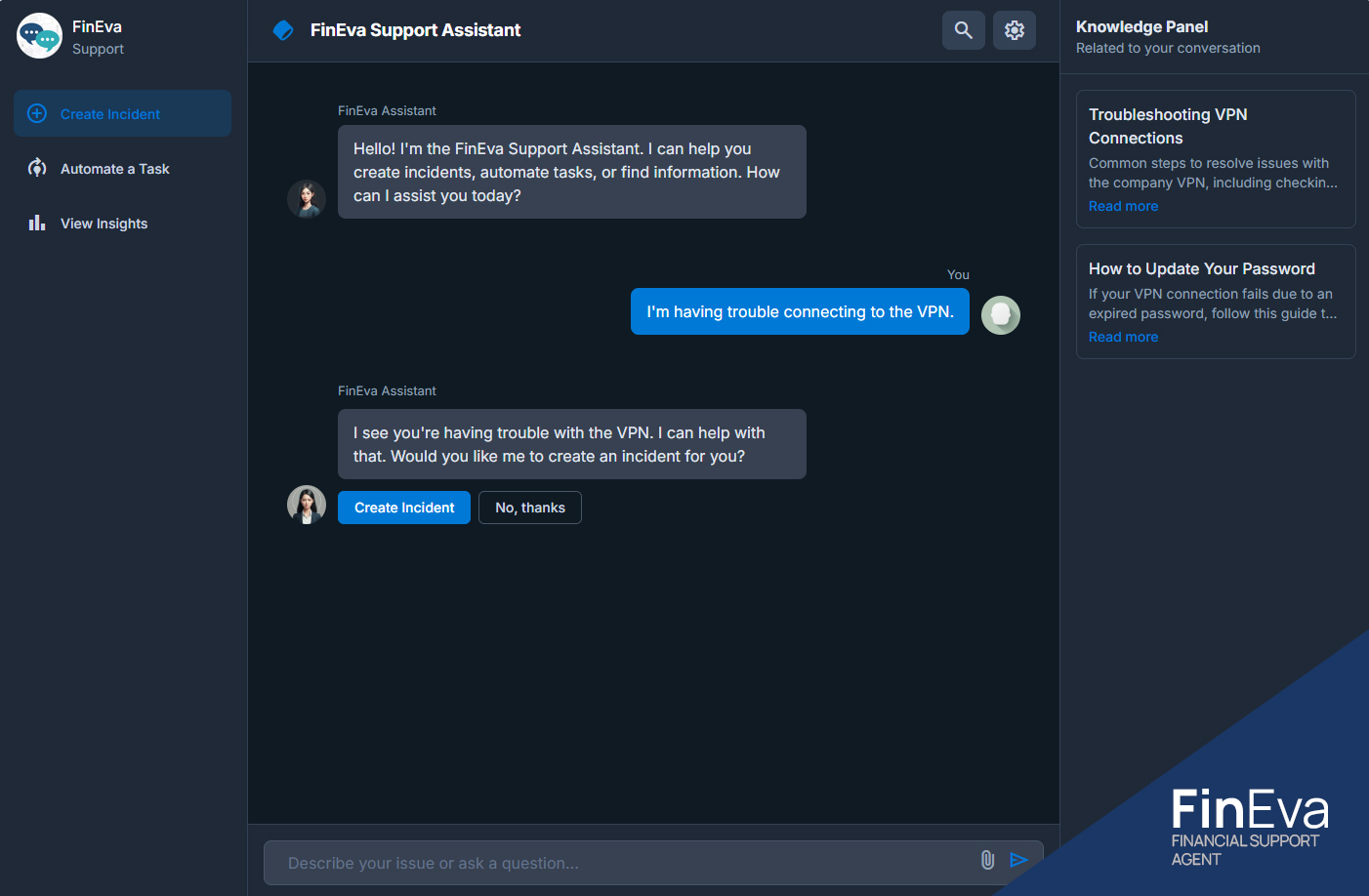
A leading financial services firm struggled to locate correct information across many systems during live interactions. This increased handling time, costs, and IT dependency.
We deployed a context-aware chatbot inside Microsoft Teams that unifies retrieval across static and live data sources, and triggers workflow automations (e.g., incident creation) directly inside chat—optimizing first-line support.
Agents needed instant, reliable answers from multiple back-office systems and a way to execute routine actions without leaving the conversation—improving speed, capacity, and experience.
A unified Teams assistant with GenAI retrieval over documents and live systems, plus one-click automations (like incident creation) so agents resolve more within the chat flow.
IT tickets avoided
Handle time reduction
Agent capacity
Customer satisfaction
The technical architecture of the AI-powered Customer Support Agent is built on a robust Microsoft ecosystem combining .NET 8, Autogen, Azure Communication Foundation, Azure OpenAI (GPT-4.1), Azure AI Foundry, and Azure AI Search. The system uses Autogen as its multi-agent orchestration layer, enabling multiple specialized agents—such as query interpreters, workflow executors, and knowledge retrievers—to collaborate dynamically in real time. These agents interact through a .NET-based backend that exposes REST APIs for integration with enterprise systems like CRM, ITSM, and HR platforms. Azure AI Search powers hybrid document retrieval (semantic + keyword), feeding relevant context into GPT-4.1 hosted on Azure AI Foundry, which generates conversational, context-aware responses.
The communication experience is delivered through Microsoft Teams, connected via Azure Communication Foundation, allowing users to chat, trigger workflows, and retrieve data directly within Teams. Azure Active Directory (AAD) secures access and roles, while Application Insights and Azure Monitor provide observability and performance telemetry. Deployed on Azure Kubernetes Service (AKS), the architecture ensures scalability, low latency, and enterprise-grade resilience. Altogether, this setup creates an intelligent, agent-driven support assistant that unifies knowledge retrieval, AI reasoning, and task automation—empowering support teams to deliver faster, more accurate, and conversational customer service experiences within Microsoft Teams.



 +91-9544522360
 business@onboard360.com